
Note
You can run this notebook on Google Colab.
Linear elasticity
This work is adapted from a previous FEniCS tutorial no longer online
Having studied a few scalar-valued problems, we now move on to a vector-valued problem. The equations of linear elasticity. Here, we’ll treat the isotropic case.
For small deformations, the governing equation is:
with the stress tensor:
and the symmetric strain rate tensor:
where \(u\) is the unknown vector displacement field, and \(\mu\) and \(\lambda\) are the Lamè parameters.
As before, the variational formulation consists of multiplying by a test function in some suitable finite element space, \(v \in V\), and integrating. Note that this time, the solution \(u\), and hence the test space \(V\) are vector-valued (so multiplication actually means taking the inner product).
We obtain
Since \(\sigma\) is actually a function of derivatives of \(u\), we must integrate this term by parts, resulting in
We also need to specify boundary conditions. We can do so either by prescribing the displacement \(u\) on the boundary, or the traction \(\sigma \cdot n\). The former is a strong or Dirichlet condition, the latter a weak or Neumann condition.
Let us decide on a concrete setting. We will solve for the displacement of a beam under its own weight clamped at one end. That is, we will take \(\Omega = [0, L] \times [0, W]\), we set \(u = (0, 0)\) on \(\Gamma_D\), the plane \(x = 0\). On all other boundaries, we have traction-free conditions.
We start, as usual, by import Firedrake and defining a mesh
[1]:
import matplotlib.pyplot as plt
[2]:
from firedrake import *
length = 1
width = 0.2
mesh = RectangleMesh(40, 20, length, width)
We need a function space for the solution variable \(u\), this space is vector valued, so we use a VectorFunctionSpace. By default, this constructs a space where the vectors have as many components as the geometric dimension of the mesh (two in this case).
[3]:
V = VectorFunctionSpace(mesh, "Lagrange", 1)
We need a boundary condition object for \(\Gamma_D\).
[4]:
bc = DirichletBC(V, Constant([0, 0]), 1)
Now let’s define the material parameters. The deformation due to gravity can be obtained by setting the load vector \(f = (0, -\rho g)\) where \(\rho\) is the material density and \(g\) the acceleration due to gravity. We’ll choose \(\rho = 0.01\), and \(g = 1\).
[5]:
rho = Constant(0.01)
g = Constant(1)
f = as_vector([0, -rho*g])
mu = Constant(1)
lambda_ = Constant(0.25)
Id = Identity(mesh.geometric_dimension) # 2x2 Identity tensor
Now we’ll define functions that construct the symbolic expressions for the stress and strain.
[6]:
def epsilon(u):
    return 0.5*(grad(u) + grad(u).T)

def sigma(u):
    return lambda_*div(u)*Id + 2*mu*epsilon(u)
The variational problem can now be solved. Passing the solver parameter "ksp_monitor": None tells PETSc to print the progress of the linear solver to screen. Firedrake uses a direct solver by default, so it should converge in one iteration.
[7]:
u = TrialFunction(V)
v = TestFunction(V)
a = inner(sigma(u), epsilon(v))*dx
L = dot(f, v)*dx

uh = Function(V)
solve(a == L, uh, bcs=bc, solver_parameters={"ksp_monitor": None})
    Residual norms for firedrake_1_ solve.
    0 KSP Residual norm 6.916415658096e-05
    1 KSP Residual norm 6.189024348352e-15
[7]:
Coefficient(WithGeometry(FunctionSpace(<firedrake.mesh.MeshTopology object at 0x7fcb33cad850>, VectorElement(FiniteElement('Lagrange', triangle, 1), dim=2), name=None), Mesh(VectorElement(FiniteElement('Lagrange', triangle, 1), dim=2), 1)), 7)
Visualising the solution
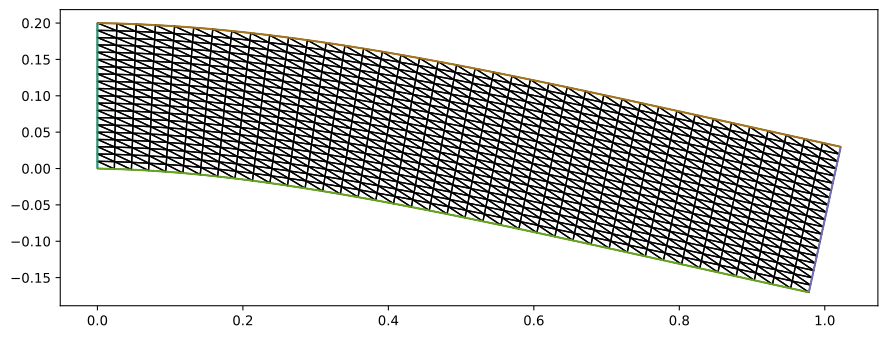
We solved the equations in displacement formulation. That is, the \(u_h\) we obtain is a perturbation to the original coordinate field of the mesh. If we want to view the output, we can either use the original mesh, or we can create a new mesh with the displaced coordinates: \(\hat{X} = X + u_h\).
[8]:
displaced_coordinates = assemble(interpolate(SpatialCoordinate(mesh) + uh, V))
displaced_mesh = Mesh(displaced_coordinates)
This created a new mesh with a coordinate field provided by displaced_coordinates that nevertheless shares a topology with the original, regular, mesh. We could, if we wanted to, go ahead and solve variational problems on this new mesh, however, we’ve only done this so we can see the elastic deformation. Here we’re using the matplotlib API for Axes objects to make the horizontal and vertical axes equally spaced.
[9]:
from firedrake.pyplot import triplot

fig, axes = plt.subplots()
triplot(displaced_mesh, axes=axes)
axes.set_aspect("equal");
Exercises
Modify the problem so that the material density \(\rho\) is not constant, but rather varies in space. For example, you could try setting \(\rho(x, y) = 0.01 + xy\). That is, the material gets denser the futher away from the clamped end you get.
Hint 1: The values for the components of
as_vectorcan be arbitrary UFL expressions.Hint 2: You can get symbolic expressions for the coordinates with
x, y = SpatialCoordinate(mesh).
[ ]:
Solving bigger problems
Up to now, we’ve only really solved quite small problems, and therefore haven’t really had to worry about tuning the solver. As we increase the size of the problem we’re solving, the direct solver approach will no longer be good enough. Firedrake uses PETSc to provide solvers, and uses PETSc solver parameters to control them.
Let’s dive straight in. We’ll write a function that solves the same elasticity problem, but takes parameters for the number of cells in the mesh, as well as a dictionary of solver options.
[10]:
def solve_elasticity(nx, ny, options=None, **kwargs):
    length = 1
    width = 0.2
    mesh = RectangleMesh(nx, ny, length, width)
    V = VectorFunctionSpace(mesh, "Lagrange", 1)
    rho = Constant(0.01)
    g = Constant(1)
    f = as_vector([0, -rho*g])
    mu = Constant(1)
    lambda_ = Constant(0.25)
    Id = Identity(mesh.geometric_dimension) # 2x2 Identity tensor

    bc = DirichletBC(V, Constant([0, 0]), 1)
    u = TrialFunction(V)
    v = TestFunction(V)
    a = inner(sigma(u), epsilon(v))*dx
    L = dot(f, v)*dx

    uh = Function(V)
    solve(a == L, uh, bcs=bc, solver_parameters=options, **kwargs)
    return uh
The problem is solved with a Krylov method, so let’s limit ourselves to just 100 iterations. Moreover, it is symmetric positive definite, so let’s use the conjugate gradient method. Let’s not worry about preconditioning for now and set "pc_type": "none".
[11]:
uh = solve_elasticity(100, 100, options={"ksp_max_it": 100, "ksp_type": "cg", "pc_type": "none"})
---------------------------------------------------------------------------
ConvergenceError                          Traceback (most recent call last)
Cell In[11], line 1
----> 1 uh = solve_elasticity(100, 100, options={"ksp_max_it": 100, "ksp_type": "cg", "pc_type": "none"})

Cell In[10], line 20, in solve_elasticity(nx, ny, options, **kwargs)
     16     a = inner(sigma(u), epsilon(v))*dx
     17     L = dot(f, v)*dx
     18
     19     uh = Function(V)
---> 20     solve(a == L, uh, bcs=bc, solver_parameters=options, **kwargs)
     21     return uh

File petsc4py/PETSc/Log.pyx:227, in petsc4py.PETSc.Log.EventDecorator.decorator.wrapped_func()
--> 227 'Could not get source, probably due dynamically evaluated source code.'

File petsc4py/PETSc/Log.pyx:228, in petsc4py.PETSc.Log.EventDecorator.decorator.wrapped_func()
--> 228 'Could not get source, probably due dynamically evaluated source code.'

File /usr/local/lib/python3.12/dist-packages/firedrake/adjoint_utils/solving.py:57, in annotate_solve.<locals>.wrapper(*args, **kwargs)
     54     tape.add_block(block)
     56 with stop_annotating():
---> 57     output = solve(*args, **kwargs)
     59 if annotate:
     60     if hasattr(args[1], "create_block_variable"):

File /usr/local/lib/python3.12/dist-packages/firedrake/solving.py:160, in solve(*args, **kwargs)
    158 # Call variational problem solver if we get an equation
    159 if isinstance(args[0], ufl.classes.Equation):
--> 160     return _solve_varproblem(*args, **kwargs)
    161 else:
    162     # Solve pre-assembled system
    163     return _la_solve(*args, **kwargs)

File /usr/local/lib/python3.12/dist-packages/firedrake/solving.py:213, in _solve_varproblem(*args, **kwargs)
    205 # Create solver and call solve
    206 solver = create_solver(problem, solver_parameters=solver_parameters,
    207                        nullspace=nullspace,
    208                        transpose_nullspace=nullspace_T,
   (...)    211                        appctx=appctx,
    212                        pre_apply_bcs=pre_apply_bcs)
--> 213 return solver.solve()

File petsc4py/PETSc/Log.pyx:227, in petsc4py.PETSc.Log.EventDecorator.decorator.wrapped_func()
--> 227 'Could not get source, probably due dynamically evaluated source code.'

File petsc4py/PETSc/Log.pyx:228, in petsc4py.PETSc.Log.EventDecorator.decorator.wrapped_func()
--> 228 'Could not get source, probably due dynamically evaluated source code.'

File /usr/local/lib/python3.12/dist-packages/firedrake/adjoint_utils/variational_solver.py:108, in NonlinearVariationalSolverMixin._ad_annotate_solve.<locals>.wrapper(self, **kwargs)
    105     tape.add_block(block)
    107 with stop_annotating():
--> 108     out = solve(self, **kwargs)
    110 if annotate:
    111     block.add_output(self._ad_problem._ad_u.create_block_variable())

File /usr/local/lib/python3.12/dist-packages/firedrake/variational_solver.py:582, in NonlinearVariationalSolver.solve(self, bounds)
    580 if problem.restrict:
    581     problem.u.assign(problem.u_restrict)
--> 582 solving_utils.check_snes_convergence(self.snes)
    584 # Grab the comm associated with the `_problem` and call PETSc's garbage cleanup routine
    585 comm = problem.u_restrict.function_space().mesh().comm

File /usr/local/lib/python3.12/dist-packages/firedrake/solving_utils.py:133, in check_snes_convergence(snes)
    131         else:
    132             msg = reason
--> 133         raise ConvergenceError(r"""Nonlinear solve failed to converge after %d nonlinear iterations.
    134 Reason:
    135    %s""" % (snes.getIterationNumber(), msg))

ConvergenceError: Nonlinear solve failed to converge after 0 nonlinear iterations.
Reason:
   DIVERGED_LINEAR_SOLVE
Oh no! We didn’t get a solution. This is because the linear system is ill conditioned. Fortunately, good preconditioning strategies exist for elasticity problems. For example, smoothed aggregation multigrid. We can access PETSc’s implementation of this scheme, GAMG, by specifying the appropriate preconditioner. In order to reduce the verbosity of the linear solver progress monitoring, we use "ksp_converged_reason": None, instead of "ksp_monitor": None.
[12]:
uh = solve_elasticity(200, 200, options={"ksp_type": "cg",
                                         "ksp_max_it": 100,
                                         "pc_type": "gamg",
                                         "pc_gamg_aggressive_square_graph": None,
                                         "pc_gamg_mis_k_minimum_degree_ordering": True,
                                         "mg_levels_pc_type": "sor",
                                         "mat_type": "aij",
                                         "ksp_converged_reason": None})
Linear firedrake_5_ solve converged due to CONVERGED_RTOL iterations 83
This is still not ideal, taking quite a few iterations. It turns out that for smoothed aggregation to work well, the preconditioner needs access to the near nullspace of the operator. That is, the null modes of the operator if no Dirichlet conditions were applied. For elasticity, these are the rigid body modes of translation and rotation. We must build these and supply them to the solver. To do so, we must create a VectorSpaceBasis:
[13]:
def solve_elasticity(nx, ny, options=None, **kwargs):
    length = 1
    width = 0.2
    mesh = RectangleMesh(nx, ny, length, width)
    V = VectorFunctionSpace(mesh, "CG", 1)
    rho = Constant(0.01)
    g = Constant(1)
    f = as_vector([0, -rho*g])
    mu = Constant(1)
    lambda_ = Constant(0.25)
    Id = Identity(mesh.geometric_dimension) # 2x2 Identity tensor
    def epsilon(u):
        return 0.5*(grad(u) + grad(u).T)

    def sigma(u):
        return lambda_*div(u)*Id + 2*mu*epsilon(u)
    bc = DirichletBC(V, Constant([0, 0]), 1)
    u = TrialFunction(V)
    v = TestFunction(V)
    a = inner(sigma(u), epsilon(v))*dx
    L = dot(f, v)*dx

    # create rigid body modes
    x, y = SpatialCoordinate(mesh)
    b0 = Function(V)
    b1 = Function(V)
    b2 = Function(V)
    b0.interpolate(Constant([1, 0]))
    b1.interpolate(Constant([0, 1]))
    b2.interpolate(as_vector([-y, x]))
    nullmodes = VectorSpaceBasis([b0, b1, b2])
    # Make sure they're orthonormal.
    nullmodes.orthonormalize()
    uh = Function(V)
    solve(a == L, uh, bcs=bc, solver_parameters=options, near_nullspace=nullmodes)
    return uh
With this done, the problem is solved in a reasonably small number of Krylov iterations.
[14]:
uh = solve_elasticity(200, 200, options={"ksp_type": "cg",
                                         "ksp_max_it": 100,
                                         "pc_type": "gamg",
                                         "pc_gamg_aggressive_square_graph": None,
                                         "pc_gamg_mis_k_minimum_degree_ordering": True,
                                         "mat_type": "aij",
                                         "ksp_converged_reason": None})
Linear firedrake_7_ solve converged due to CONVERGED_RTOL iterations 35
Exercise
Study what happens to the number of iterations for this last setup as you change the mesh resolution. Try, perhaps, 10, 50, 100, and 200.
[ ]: