
Note
You can run this notebook on Google Colab.
Solving adjoint problems
Firedrake has built-in capabilities for differentiating the solution of a PDE with respect to any of its inputs. These are documented in the manual. Here we will explore these capabilities using a the same Burgers equation example that we already explored when we learned how to solve nonlinear problems. As before, we will define the equation in one spatial dimension and avoid considering boundary conditions by selecting a periodic domain:
Applying finite element in time and implicit Euler in space, the problem becomes at each timestep find \(u^{n+1}\in V\) such that:
As usual, we start by setting up plotting:
[1]:
import matplotlib.pyplot as plt
… and importing Firedrake:
[2]:
from firedrake import *
This is where the code is slightly different because we’re solving an adjoint problem. Firedrake uses pyadjoint to deliver its adjoint capability, but the relevant parts of the Pyadjoint interface are exposed via the firedrake.adjoint module.
[3]:
from firedrake.adjoint import *
Executing the adjoint problem depends on having recorded all of the operations on which the results of the PDE depend. We switch on the recording thus:
[4]:
continue_annotation()
[4]:
True
We next define the mesh, initial conditions and residual for the Burgers equation as we have done in previous notebooks.
[5]:
n = 100
with stop_annotating():
    mesh = PeriodicIntervalMesh(n, length=2)
x = SpatialCoordinate(mesh)[0]
nu = Constant(1e-2)
V = FunctionSpace(mesh, "Lagrange", 2)
u_n1 = Function(V, name="u^{n+1}")
u_n = Function(V, name="u^{n}")
v = TestFunction(V)
u_init = Function(V).interpolate(sin(2*pi*x))
u_n.assign(u_init)
dt = 1.0 / n
F = (((u_n1 - u_n)/dt) * v +
     u_n1 * u_n1.dx(0) * v +
     nu*u_n1.dx(0)*v.dx(0))*dx
Now we timestep the equations as usual:
[6]:
problem = NonlinearVariationalProblem(F, u_n1)
solver = NonlinearVariationalSolver(problem)
results = [Function(u_n)]
timesteps = 50
for t in ProgressBar("Time step").iter(range(timesteps)):
    solver.solve()
    u_n.assign(u_n1)
    results.append(Function(u_n))
Time step ▣▣▣▣▣▣▣▣▣▣▣▣▣▣▣▣▣▣▣▣▣▣▣▣▣▣▣▣▣▣▣▣▣▣▣▣▣▣▣▣▣▣▣▣▣▣▣▣▣▣ 50/50 [0:00:00]
The basic form of adjoint computiation computes the derivative of a scalar outcome of a PDE with respect to one or more inputs. Here we’d just like to see how the solution of the PDE at the end of the time interval depends on the initial conditions, so we choose the squared \(L^2\) norm of the final solution as our functional:
[7]:
J = assemble(u_n*u_n*dx)
We’ve now completed the forward solution. We want to stop recording so that any computations we do on the results aren’t part of the tape:
[8]:
pause_annotation()
Just as with the forward calculation, it’s helpful to have a visualisation of the execution of the model. However, the adjoint calculations will be executed automatically, so we can’t directly attach a progress bar. Instead, we pass a progress bar class to the tape and let it apply it automatically:
[9]:
get_working_tape().progress_bar = ProgressBar
We select the initial conditions of the simulation as the control. The way we achieve this in code is by defining a ReducedFunctional with the initial conditions as the Control:
[10]:
Jhat = ReducedFunctional(J, Control(u_init))
The reduced functional is the core object in any adjoint calculation. For example, we can compute the gradient of a ReducedFunctional as follows. Notice the progress bar. It has 154 entries in it in contrast to the 50 timesteps. This is because the adjoint calculation records and replays individual Firedrake operations such as solve and assign rather than whole timesteps.
[11]:
dJ = Jhat.derivative(apply_riesz=True)
Evaluating adjoint ▣▣▣▣▣▣▣▣▣▣▣▣▣▣▣▣▣▣▣▣▣▣▣▣▣▣▣▣▣▣▣▣▣▣▣▣▣▣▣▣▣▣▣▣▣▣▣▣▣▣ 154/154 [0:00:01]
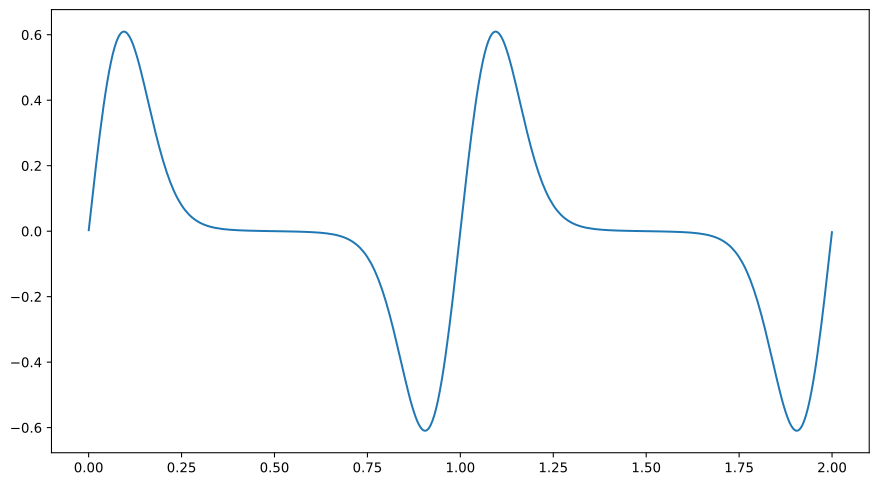
Let’s look at the gradient we’ve calculated. Can you intuitively work out why this is the right derivative?
[12]:
from firedrake.pyplot import plot

fig, axes = plt.subplots()

paths=plot(dJ, axes=axes)
Exercise 1
The reduced functional defines a function:
Where \(m\) is the control. As well as differentiating the functional, it’s possible to evaluate it for a new intial condition. This is achieved by calling the reduced functional:
Jhat(u_new)
a.
Try evaluating Jhat for a new initial condition. You’ll still need to use a periodic funcition, but you could change the frequency of the wave, or try a more adventurous but still periodic function.
b.
You can access the solution of the last solve in the reduced functional with get_solve_blocks()[-1].get_outputs()[0].saved_output. See how the solution changes for different values of the initial condition.
c.
The gradient returned by Jhat.derivative(apply_riesz=True) is linearised around the solution for the last state at which the reduced functional was evaluated. Plot the gradient for different initial conditions and see if you can intuit why it looks like it does.
[ ]:
[ ]:
Taylor tests
How do we know that the gradient we have calculated above is correct? The Taylor test provides us a very sensitive test of this. Almost any error in the computation of the gradient will cause its convergence rate to drop below 2. We evaluate the Taylor test at our original functional and with a perturbation of a constant function:
[13]:
taylor_test(Jhat, u_init, assemble(interpolate(Constant(1.), V)))
Evaluating functional ▣▣▣▣▣▣▣▣▣▣▣▣▣▣▣▣▣▣▣▣▣▣▣▣▣▣▣▣▣▣▣▣▣▣▣▣▣▣▣▣▣▣▣▣▣▣▣▣▣▣ 154/154 [0:00:00]
Evaluating adjoint ▣▣▣▣▣▣▣▣▣▣▣▣▣▣▣▣▣▣▣▣▣▣▣▣▣▣▣▣▣▣▣▣▣▣▣▣▣▣▣▣▣▣▣▣▣▣▣▣▣▣ 154/154 [0:00:00]
Evaluating functional ▣▣▣▣▣▣▣▣▣▣▣▣▣▣▣▣▣▣▣▣▣▣▣▣▣▣▣▣▣▣▣▢▢▢▢▢▢▢▢▢▢▢▢▢▢▢▢▢▢▢ 97/154 [0:00:00]
Running Taylor test
Evaluating functional ▣▣▣▣▣▣▣▣▣▣▣▣▣▣▣▣▣▣▣▣▣▣▣▣▣▣▣▣▣▣▣▣▣▣▣▣▣▣▣▣▣▣▣▣▣▣▣▣▣▣ 154/154 [0:00:00]
Evaluating functional ▣▣▣▣▣▣▣▣▣▣▣▣▣▣▣▣▣▣▣▣▣▣▣▣▣▣▣▣▣▣▣▣▣▣▣▣▣▣▣▣▣▣▣▣▣▣▣▣▣▣ 154/154 [0:00:00]
Evaluating functional ▣▣▣▣▣▣▣▣▣▣▣▣▣▣▣▣▣▣▣▣▣▣▣▣▣▣▣▣▣▣▣▣▣▣▣▣▣▣▣▣▣▣▣▣▣▣▣▣▣▣ 154/154 [0:00:00]
Evaluating functional ▣▣▣▣▣▣▣▣▣▣▣▣▣▣▣▣▣▣▣▣▣▣▣▣▣▣▣▣▣▣▣▣▣▣▣▣▣▣▣▣▣▣▣▣▣▣▣▣▣▣ 154/154 [0:00:00]
Computed residuals: [0.00019655556020483326, 4.913959213377186e-05, 1.228494306649209e-05, 3.071238598775399e-06]
Computed convergence rates: [1.999979387328534, 1.9999947114874383, 1.9999986696135972]
[13]:
1.999979387328534
## Examining the adjoint calculation
When we first studied the Burgers equation we plotted an animation of the solution over time. As a reminder:
[14]:
from firedrake.pyplot import plot
from matplotlib.animation import FuncAnimation

fig, axes = plt.subplots()

def animate(u):
    axes.clear()
    plot(u, axes=axes)
    axes.set_ylim((-1., 1.))

interval = 4e3 * float(dt)
animation = FuncAnimation(fig, animate, frames=results, interval=interval)

from IPython.display import HTML
HTML(animation.to_jshtml())
[14]:
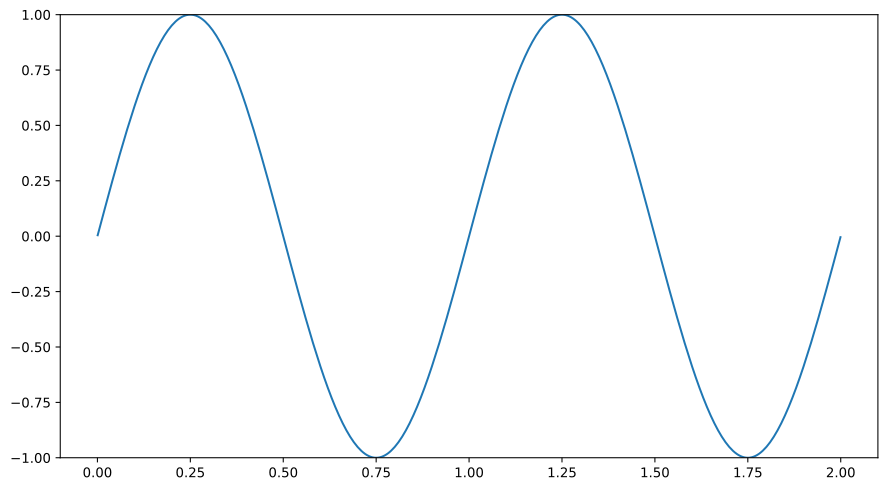
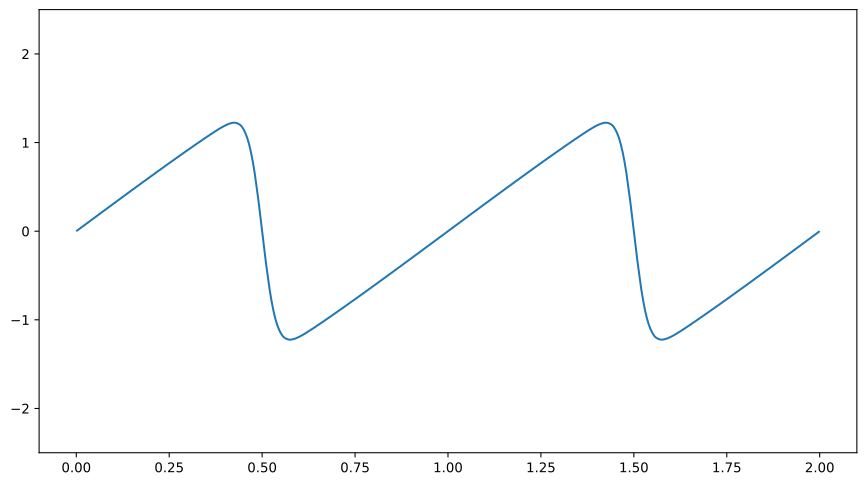
In order to understand how the adjoint solution works, it’s helpful to do the same for the adjoint. We can extract the adjoint solutions to the PDE for each timestep as follows:
[15]:
adjoints = [block.get_dependencies()[0].adj_value for block in get_solve_blocks()[::-1]]
We deliberately extracted the blocks in reverse order because the adjoint is solved in reverse order. The adjoint value of the control is the last solve value in the sequence so we add that:
[16]:
adjoints += [Jhat.controls[0].adj_value]
Now, if we take a look at those variables…
[17]:
adjoints
[17]:
[Cofunction(FiredrakeDualSpace(FunctionSpace(<firedrake.mesh.MeshTopology object at 0x7f8a3a615400>, FiniteElement('Lagrange', interval, 2), name=None), Mesh(VectorElement(FiniteElement('Discontinuous Lagrange', interval, 1, variant='equispaced'), dim=1), 1)), 2829),
 Cofunction(FiredrakeDualSpace(FunctionSpace(<firedrake.mesh.MeshTopology object at 0x7f8a3a615400>, FiniteElement('Lagrange', interval, 2), name=None), Mesh(VectorElement(FiniteElement('Discontinuous Lagrange', interval, 1, variant='equispaced'), dim=1), 1)), 2850),
 Cofunction(FiredrakeDualSpace(FunctionSpace(<firedrake.mesh.MeshTopology object at 0x7f8a3a615400>, FiniteElement('Lagrange', interval, 2), name=None), Mesh(VectorElement(FiniteElement('Discontinuous Lagrange', interval, 1, variant='equispaced'), dim=1), 1)), 2871),
 Cofunction(FiredrakeDualSpace(FunctionSpace(<firedrake.mesh.MeshTopology object at 0x7f8a3a615400>, FiniteElement('Lagrange', interval, 2), name=None), Mesh(VectorElement(FiniteElement('Discontinuous Lagrange', interval, 1, variant='equispaced'), dim=1), 1)), 2892),
 Cofunction(FiredrakeDualSpace(FunctionSpace(<firedrake.mesh.MeshTopology object at 0x7f8a3a615400>, FiniteElement('Lagrange', interval, 2), name=None), Mesh(VectorElement(FiniteElement('Discontinuous Lagrange', interval, 1, variant='equispaced'), dim=1), 1)), 2913),
 Cofunction(FiredrakeDualSpace(FunctionSpace(<firedrake.mesh.MeshTopology object at 0x7f8a3a615400>, FiniteElement('Lagrange', interval, 2), name=None), Mesh(VectorElement(FiniteElement('Discontinuous Lagrange', interval, 1, variant='equispaced'), dim=1), 1)), 2934),
 Cofunction(FiredrakeDualSpace(FunctionSpace(<firedrake.mesh.MeshTopology object at 0x7f8a3a615400>, FiniteElement('Lagrange', interval, 2), name=None), Mesh(VectorElement(FiniteElement('Discontinuous Lagrange', interval, 1, variant='equispaced'), dim=1), 1)), 2955),
 Cofunction(FiredrakeDualSpace(FunctionSpace(<firedrake.mesh.MeshTopology object at 0x7f8a3a615400>, FiniteElement('Lagrange', interval, 2), name=None), Mesh(VectorElement(FiniteElement('Discontinuous Lagrange', interval, 1, variant='equispaced'), dim=1), 1)), 2976),
 Cofunction(FiredrakeDualSpace(FunctionSpace(<firedrake.mesh.MeshTopology object at 0x7f8a3a615400>, FiniteElement('Lagrange', interval, 2), name=None), Mesh(VectorElement(FiniteElement('Discontinuous Lagrange', interval, 1, variant='equispaced'), dim=1), 1)), 2997),
 Cofunction(FiredrakeDualSpace(FunctionSpace(<firedrake.mesh.MeshTopology object at 0x7f8a3a615400>, FiniteElement('Lagrange', interval, 2), name=None), Mesh(VectorElement(FiniteElement('Discontinuous Lagrange', interval, 1, variant='equispaced'), dim=1), 1)), 3018),
 Cofunction(FiredrakeDualSpace(FunctionSpace(<firedrake.mesh.MeshTopology object at 0x7f8a3a615400>, FiniteElement('Lagrange', interval, 2), name=None), Mesh(VectorElement(FiniteElement('Discontinuous Lagrange', interval, 1, variant='equispaced'), dim=1), 1)), 3039),
 Cofunction(FiredrakeDualSpace(FunctionSpace(<firedrake.mesh.MeshTopology object at 0x7f8a3a615400>, FiniteElement('Lagrange', interval, 2), name=None), Mesh(VectorElement(FiniteElement('Discontinuous Lagrange', interval, 1, variant='equispaced'), dim=1), 1)), 3060),
 Cofunction(FiredrakeDualSpace(FunctionSpace(<firedrake.mesh.MeshTopology object at 0x7f8a3a615400>, FiniteElement('Lagrange', interval, 2), name=None), Mesh(VectorElement(FiniteElement('Discontinuous Lagrange', interval, 1, variant='equispaced'), dim=1), 1)), 3081),
 Cofunction(FiredrakeDualSpace(FunctionSpace(<firedrake.mesh.MeshTopology object at 0x7f8a3a615400>, FiniteElement('Lagrange', interval, 2), name=None), Mesh(VectorElement(FiniteElement('Discontinuous Lagrange', interval, 1, variant='equispaced'), dim=1), 1)), 3102),
 Cofunction(FiredrakeDualSpace(FunctionSpace(<firedrake.mesh.MeshTopology object at 0x7f8a3a615400>, FiniteElement('Lagrange', interval, 2), name=None), Mesh(VectorElement(FiniteElement('Discontinuous Lagrange', interval, 1, variant='equispaced'), dim=1), 1)), 3123),
 Cofunction(FiredrakeDualSpace(FunctionSpace(<firedrake.mesh.MeshTopology object at 0x7f8a3a615400>, FiniteElement('Lagrange', interval, 2), name=None), Mesh(VectorElement(FiniteElement('Discontinuous Lagrange', interval, 1, variant='equispaced'), dim=1), 1)), 3144),
 Cofunction(FiredrakeDualSpace(FunctionSpace(<firedrake.mesh.MeshTopology object at 0x7f8a3a615400>, FiniteElement('Lagrange', interval, 2), name=None), Mesh(VectorElement(FiniteElement('Discontinuous Lagrange', interval, 1, variant='equispaced'), dim=1), 1)), 3165),
 Cofunction(FiredrakeDualSpace(FunctionSpace(<firedrake.mesh.MeshTopology object at 0x7f8a3a615400>, FiniteElement('Lagrange', interval, 2), name=None), Mesh(VectorElement(FiniteElement('Discontinuous Lagrange', interval, 1, variant='equispaced'), dim=1), 1)), 3186),
 Cofunction(FiredrakeDualSpace(FunctionSpace(<firedrake.mesh.MeshTopology object at 0x7f8a3a615400>, FiniteElement('Lagrange', interval, 2), name=None), Mesh(VectorElement(FiniteElement('Discontinuous Lagrange', interval, 1, variant='equispaced'), dim=1), 1)), 3207),
 Cofunction(FiredrakeDualSpace(FunctionSpace(<firedrake.mesh.MeshTopology object at 0x7f8a3a615400>, FiniteElement('Lagrange', interval, 2), name=None), Mesh(VectorElement(FiniteElement('Discontinuous Lagrange', interval, 1, variant='equispaced'), dim=1), 1)), 3228),
 Cofunction(FiredrakeDualSpace(FunctionSpace(<firedrake.mesh.MeshTopology object at 0x7f8a3a615400>, FiniteElement('Lagrange', interval, 2), name=None), Mesh(VectorElement(FiniteElement('Discontinuous Lagrange', interval, 1, variant='equispaced'), dim=1), 1)), 3249),
 Cofunction(FiredrakeDualSpace(FunctionSpace(<firedrake.mesh.MeshTopology object at 0x7f8a3a615400>, FiniteElement('Lagrange', interval, 2), name=None), Mesh(VectorElement(FiniteElement('Discontinuous Lagrange', interval, 1, variant='equispaced'), dim=1), 1)), 3270),
 Cofunction(FiredrakeDualSpace(FunctionSpace(<firedrake.mesh.MeshTopology object at 0x7f8a3a615400>, FiniteElement('Lagrange', interval, 2), name=None), Mesh(VectorElement(FiniteElement('Discontinuous Lagrange', interval, 1, variant='equispaced'), dim=1), 1)), 3291),
 Cofunction(FiredrakeDualSpace(FunctionSpace(<firedrake.mesh.MeshTopology object at 0x7f8a3a615400>, FiniteElement('Lagrange', interval, 2), name=None), Mesh(VectorElement(FiniteElement('Discontinuous Lagrange', interval, 1, variant='equispaced'), dim=1), 1)), 3312),
 Cofunction(FiredrakeDualSpace(FunctionSpace(<firedrake.mesh.MeshTopology object at 0x7f8a3a615400>, FiniteElement('Lagrange', interval, 2), name=None), Mesh(VectorElement(FiniteElement('Discontinuous Lagrange', interval, 1, variant='equispaced'), dim=1), 1)), 3333),
 Cofunction(FiredrakeDualSpace(FunctionSpace(<firedrake.mesh.MeshTopology object at 0x7f8a3a615400>, FiniteElement('Lagrange', interval, 2), name=None), Mesh(VectorElement(FiniteElement('Discontinuous Lagrange', interval, 1, variant='equispaced'), dim=1), 1)), 3354),
 Cofunction(FiredrakeDualSpace(FunctionSpace(<firedrake.mesh.MeshTopology object at 0x7f8a3a615400>, FiniteElement('Lagrange', interval, 2), name=None), Mesh(VectorElement(FiniteElement('Discontinuous Lagrange', interval, 1, variant='equispaced'), dim=1), 1)), 3375),
 Cofunction(FiredrakeDualSpace(FunctionSpace(<firedrake.mesh.MeshTopology object at 0x7f8a3a615400>, FiniteElement('Lagrange', interval, 2), name=None), Mesh(VectorElement(FiniteElement('Discontinuous Lagrange', interval, 1, variant='equispaced'), dim=1), 1)), 3396),
 Cofunction(FiredrakeDualSpace(FunctionSpace(<firedrake.mesh.MeshTopology object at 0x7f8a3a615400>, FiniteElement('Lagrange', interval, 2), name=None), Mesh(VectorElement(FiniteElement('Discontinuous Lagrange', interval, 1, variant='equispaced'), dim=1), 1)), 3417),
 Cofunction(FiredrakeDualSpace(FunctionSpace(<firedrake.mesh.MeshTopology object at 0x7f8a3a615400>, FiniteElement('Lagrange', interval, 2), name=None), Mesh(VectorElement(FiniteElement('Discontinuous Lagrange', interval, 1, variant='equispaced'), dim=1), 1)), 3438),
 Cofunction(FiredrakeDualSpace(FunctionSpace(<firedrake.mesh.MeshTopology object at 0x7f8a3a615400>, FiniteElement('Lagrange', interval, 2), name=None), Mesh(VectorElement(FiniteElement('Discontinuous Lagrange', interval, 1, variant='equispaced'), dim=1), 1)), 3459),
 Cofunction(FiredrakeDualSpace(FunctionSpace(<firedrake.mesh.MeshTopology object at 0x7f8a3a615400>, FiniteElement('Lagrange', interval, 2), name=None), Mesh(VectorElement(FiniteElement('Discontinuous Lagrange', interval, 1, variant='equispaced'), dim=1), 1)), 3480),
 Cofunction(FiredrakeDualSpace(FunctionSpace(<firedrake.mesh.MeshTopology object at 0x7f8a3a615400>, FiniteElement('Lagrange', interval, 2), name=None), Mesh(VectorElement(FiniteElement('Discontinuous Lagrange', interval, 1, variant='equispaced'), dim=1), 1)), 3501),
 Cofunction(FiredrakeDualSpace(FunctionSpace(<firedrake.mesh.MeshTopology object at 0x7f8a3a615400>, FiniteElement('Lagrange', interval, 2), name=None), Mesh(VectorElement(FiniteElement('Discontinuous Lagrange', interval, 1, variant='equispaced'), dim=1), 1)), 3522),
 Cofunction(FiredrakeDualSpace(FunctionSpace(<firedrake.mesh.MeshTopology object at 0x7f8a3a615400>, FiniteElement('Lagrange', interval, 2), name=None), Mesh(VectorElement(FiniteElement('Discontinuous Lagrange', interval, 1, variant='equispaced'), dim=1), 1)), 3543),
 Cofunction(FiredrakeDualSpace(FunctionSpace(<firedrake.mesh.MeshTopology object at 0x7f8a3a615400>, FiniteElement('Lagrange', interval, 2), name=None), Mesh(VectorElement(FiniteElement('Discontinuous Lagrange', interval, 1, variant='equispaced'), dim=1), 1)), 3564),
 Cofunction(FiredrakeDualSpace(FunctionSpace(<firedrake.mesh.MeshTopology object at 0x7f8a3a615400>, FiniteElement('Lagrange', interval, 2), name=None), Mesh(VectorElement(FiniteElement('Discontinuous Lagrange', interval, 1, variant='equispaced'), dim=1), 1)), 3585),
 Cofunction(FiredrakeDualSpace(FunctionSpace(<firedrake.mesh.MeshTopology object at 0x7f8a3a615400>, FiniteElement('Lagrange', interval, 2), name=None), Mesh(VectorElement(FiniteElement('Discontinuous Lagrange', interval, 1, variant='equispaced'), dim=1), 1)), 3606),
 Cofunction(FiredrakeDualSpace(FunctionSpace(<firedrake.mesh.MeshTopology object at 0x7f8a3a615400>, FiniteElement('Lagrange', interval, 2), name=None), Mesh(VectorElement(FiniteElement('Discontinuous Lagrange', interval, 1, variant='equispaced'), dim=1), 1)), 3627),
 Cofunction(FiredrakeDualSpace(FunctionSpace(<firedrake.mesh.MeshTopology object at 0x7f8a3a615400>, FiniteElement('Lagrange', interval, 2), name=None), Mesh(VectorElement(FiniteElement('Discontinuous Lagrange', interval, 1, variant='equispaced'), dim=1), 1)), 3648),
 Cofunction(FiredrakeDualSpace(FunctionSpace(<firedrake.mesh.MeshTopology object at 0x7f8a3a615400>, FiniteElement('Lagrange', interval, 2), name=None), Mesh(VectorElement(FiniteElement('Discontinuous Lagrange', interval, 1, variant='equispaced'), dim=1), 1)), 3669),
 Cofunction(FiredrakeDualSpace(FunctionSpace(<firedrake.mesh.MeshTopology object at 0x7f8a3a615400>, FiniteElement('Lagrange', interval, 2), name=None), Mesh(VectorElement(FiniteElement('Discontinuous Lagrange', interval, 1, variant='equispaced'), dim=1), 1)), 3690),
 Cofunction(FiredrakeDualSpace(FunctionSpace(<firedrake.mesh.MeshTopology object at 0x7f8a3a615400>, FiniteElement('Lagrange', interval, 2), name=None), Mesh(VectorElement(FiniteElement('Discontinuous Lagrange', interval, 1, variant='equispaced'), dim=1), 1)), 3711),
 Cofunction(FiredrakeDualSpace(FunctionSpace(<firedrake.mesh.MeshTopology object at 0x7f8a3a615400>, FiniteElement('Lagrange', interval, 2), name=None), Mesh(VectorElement(FiniteElement('Discontinuous Lagrange', interval, 1, variant='equispaced'), dim=1), 1)), 3732),
 Cofunction(FiredrakeDualSpace(FunctionSpace(<firedrake.mesh.MeshTopology object at 0x7f8a3a615400>, FiniteElement('Lagrange', interval, 2), name=None), Mesh(VectorElement(FiniteElement('Discontinuous Lagrange', interval, 1, variant='equispaced'), dim=1), 1)), 3753),
 Cofunction(FiredrakeDualSpace(FunctionSpace(<firedrake.mesh.MeshTopology object at 0x7f8a3a615400>, FiniteElement('Lagrange', interval, 2), name=None), Mesh(VectorElement(FiniteElement('Discontinuous Lagrange', interval, 1, variant='equispaced'), dim=1), 1)), 3774),
 Cofunction(FiredrakeDualSpace(FunctionSpace(<firedrake.mesh.MeshTopology object at 0x7f8a3a615400>, FiniteElement('Lagrange', interval, 2), name=None), Mesh(VectorElement(FiniteElement('Discontinuous Lagrange', interval, 1, variant='equispaced'), dim=1), 1)), 3795),
 Cofunction(FiredrakeDualSpace(FunctionSpace(<firedrake.mesh.MeshTopology object at 0x7f8a3a615400>, FiniteElement('Lagrange', interval, 2), name=None), Mesh(VectorElement(FiniteElement('Discontinuous Lagrange', interval, 1, variant='equispaced'), dim=1), 1)), 3816),
 Cofunction(FiredrakeDualSpace(FunctionSpace(<firedrake.mesh.MeshTopology object at 0x7f8a3a615400>, FiniteElement('Lagrange', interval, 2), name=None), Mesh(VectorElement(FiniteElement('Discontinuous Lagrange', interval, 1, variant='equispaced'), dim=1), 1)), 3837),
 None,
 Cofunction(FiredrakeDualSpace(FunctionSpace(<firedrake.mesh.MeshTopology object at 0x7f8a3a615400>, FiniteElement('Lagrange', interval, 2), name=None), Mesh(VectorElement(FiniteElement('Discontinuous Lagrange', interval, 1, variant='equispaced'), dim=1), 1)), 3858)]
The adjoint variables are, as expected, cofunctions. To recover the adjoint solutions in a form we can visualise, we take the Riesz represntation to recover Functions:
[18]:
adjoints = [a.riesz_representation(riesz_map="L2") for a in adjoints if a]
Now we can visualise the adjoint solution:
[19]:
fig, axes = plt.subplots()

def animate(u):
    axes.clear()
    plot(u, axes=axes)
    axes.set_ylim((-2.5, 2.5))

interval = 4e3 * float(dt)
animation = FuncAnimation(fig, animate, frames=adjoints, interval=interval)

from IPython.display import HTML
HTML(animation.to_jshtml())
[19]:
## Exercise 2
Go back to the Poisson equation example, and solve Poisson’s equation with Dirichlet boundary conditions. Find \(u\) such that:
Choose a suitable forcing function \(f\) and evaluate the functional:
Create a reduced functional and conduct a Taylor test in order to establish that your implementation is correct. Before you start, you will need to remove the recording of the Burgers equation from the tape:
[20]:
get_working_tape().clear_tape()
continue_annotation()
[20]:
True
[ ]:
[ ]:
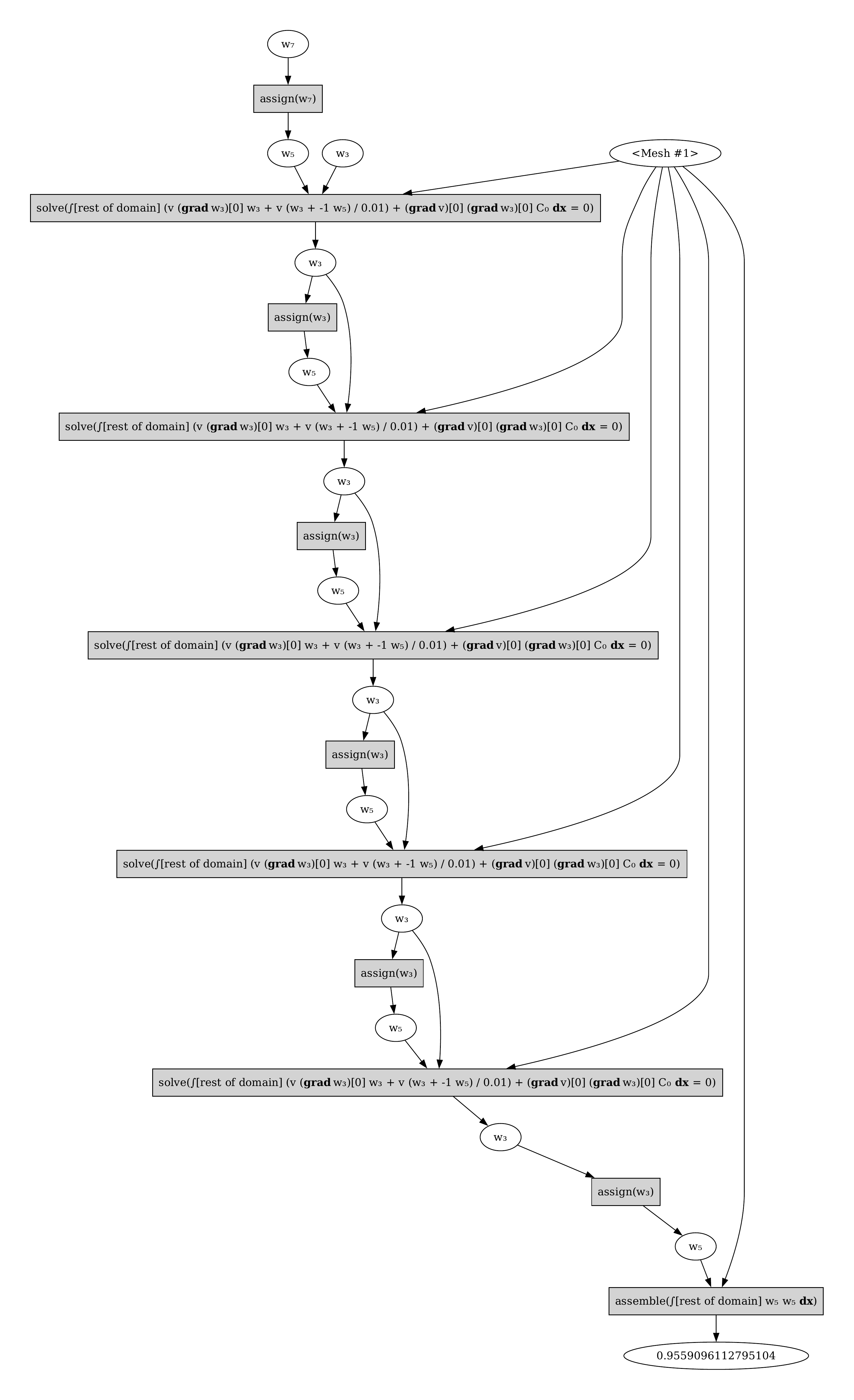
## Visualising the tape
An exceptionally useful aid to understanding the computation of the adjoint is to produce a visual representation of the tape. To produce a managable sized figure, we’ll rerun the Burgers equation with just 5 timesteps:
[21]:
tape=get_working_tape()
continue_annotation()
tape.clear_tape()
u_n.assign(u_init)
timesteps = 5
for t in ProgressBar("Time step").iter(range(timesteps)):
    solver.solve()
    u_n.assign(u_n1)
J = assemble(u_n*u_n*dx)
pause_annotation()
Time step ▣▣▣▣▣▣▣▣▣▣▣▣▣▣▣▣▣▣▣▣▣▣▣▣▣▣▣▣▣▣▣▣▣▣▣▣▣▣▣▣▣▣▣▣▣▣▣▣▣▣ 5/5 [0:00:00]
We now need to install a few packages that may not be installed automatically. On Ubuntu (including Colab) run:
[ ]:
!apt update
!apt install graphviz libgraphviz-dev poppler-utils fonts-dejavu
MacOS users are likely to need:
[ ]:
!brew install graphviz poppler
Users of all OSs will need the following, though Mac users may need to follow specific instructions for pygraphviz:
[ ]:
!pip install networkx pygraphviz pdf2image
[22]:
tape.visualise("tape.pdf")
Fontconfig warning: "/usr/share/fontconfig/conf.avail/05-reset-dirs-sample.conf", line 6: unknown element "reset-dirs"
[23]:
from pdf2image import convert_from_path

images = convert_from_path("tape.pdf")
images[0]  # first page
[23]:
[ ]:
[ ]: