
Solving partial differential equations with Firedrake
We hosted a 2.5-day in-person tutorial on Firedrake at the Mathematical Institute, University of Oxford from 18-20 March 2026. This training event was kindly supported by the Collaborative Computational Project on Data-centric Computational Mechanics and the Computational Science Centre for Research Communities (CoSeC).
The tutorial is aimed at all levels, from MSc students to senior faculty and those solving partial differential equations in industry. Only a basic passing knowledge of finite elements is necessary, although of course knowing more background is still useful.
The course covers both the basics of solving stationary and time-dependent problems, as well as various advanced topics like geometric multigrid and 𝑝-multigrid solvers, high-order mesh generation and adaptive mesh refinement with Netgen, nonlinear problems, mixed formulations and block preconditioners, eigenvalue problems, and adjoints.
Attendees need to bring a laptop. Installing Firedrake (see the download page for details) is optional, as it will be also be possible to join the tutorial using the cloud. Installing Paraview for visualisation before the course is recommended.
Registration
Registration of £25 covered tea, coffee, and biscuits. Registration closed on 6 March 2026.
Where and when
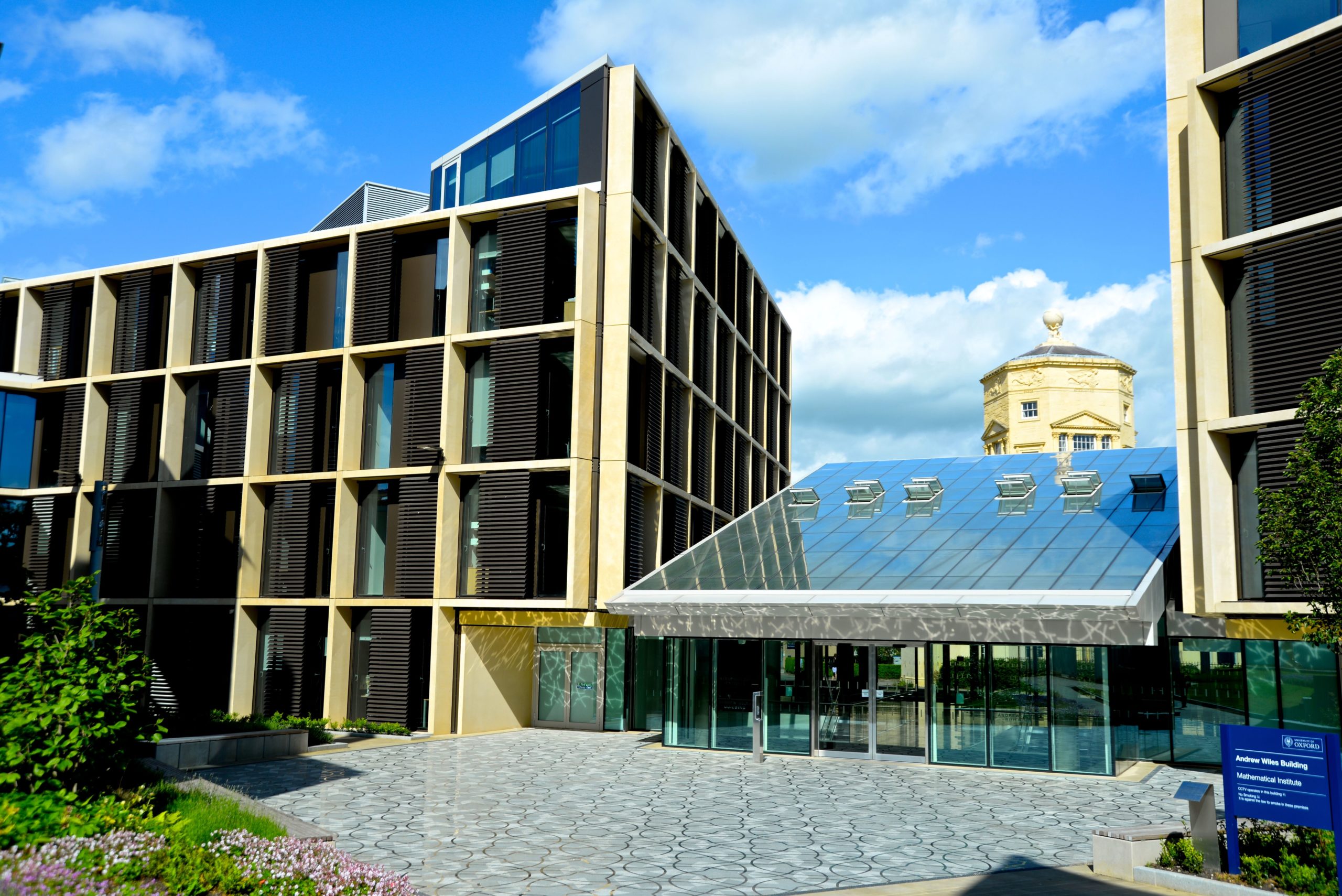
The conference took place in the Andrew Wiles Building. Its main entrance is located on Woodstock Road (see here for the precise location). Take some care in navigation, as Google Maps sometimes directs people to the old mathematics building on St. Giles.
The course will begin at 13:00 on March 18 and end at 16:00 on March 20.
Schedule
Wed Mar 18 (room L4)
Time |
Session |
|---|---|
13:00-14:45 |
Introduction. Poisson. Multigrid |
14:45-15:15 |
Coffee break |
15:15–17:00 |
Meshing with Netgen. Adaptivity |
Thu Mar 19 (room L4)
Time |
Session |
|---|---|
09:00-10:45 |
Boundaries. Nonlinearity |
10:45-11:15 |
Coffee break |
11:15–13:00 |
Time-dependent problems |
13:00-14:30 |
Lunch |
14:30-15:45 |
Mixed problems. Navier-Stokes |
15:45-16:15 |
Coffee break |
16:15-18:00 |
Hyperelasticity. Multiple solutions |
Fri Mar 20 (room L2)
Time |
Session |
|---|---|
09:00-10:45 |
Eigenvalue problems |
10:45-11:15 |
Coffee break |
11:15–13:00 |
Block preconditioners |
13:00-14:30 |
Lunch |
14:30-16:00 |
Adjoints. Optimisation problems |
Travel to Oxford
(This advice is an adaptation of Mike Giles’ advice.)
Coming to Oxford from abroad, the best options are:
Flying to Heathrow
This is usually the best option for those flying long distance. There is an excellent direct bus service to Oxford (when you approach the bus the driver will ask which stop in Oxford you want; tell the driver you want to go to Gloucester Green bus station, “Gloucester” is pronounced “gloster”) with 2-3 buses per hour taking 80-90 minutes from the Heathrow Central Bus Station (Terminals 1-3) and Terminal 5. Those flying into Terminal 4 must first change and take local transport at Heathrow to get to Terminal 5.
Flying to Birmingham
This is a good option for European flights; Birmingham is a much smaller airport than Heathrow and is more convenient. There is a regular train service to Oxford from the adjacent Birmingham International station. There is usually one train per hour, and they take about an hour. The trains can get quite busy, booking in advance is advisable.
Other, less convenient options are:
Flying to Gatwick: the direct bus service is less frequent and takes up to 2.5 hours.
Flying to Luton or Stansted: two more airports near London but neither has convenient public transport links to Oxford.
Eurostar train to St Pancras station in London: onward travel to Oxford requires a 30-minute underground train journey to Paddington station, then an hour’s train journey to Oxford.
Organising committee
Patrick Farrell, University of Oxford
Pablo Brubeck, University of Oxford
Conference photo
